Automated Visual Inspection Manufacturing: How Indian Exporters Stop Costly Port Rejections
A single unreadable barcode or scratched regulatory label will hold an export container at Nhava Sheva or Chennai Port for ten days, racking up demurrage fees that obliterate the margin on an entire production run. When foreign buyers slap chargebacks on your invoice for compliance defects, automated visual inspection manufacturing is the only thing standing between a profitable quarter and a massive write-down. If you are shipping physical goods out of Indian industrial corridors to overseas clients, relying on manual clipboard spot-checks at the end of the packing line is financial negligence.
India is pushing hard toward $1 trillion in annual merchandise exports by 2030. Reaching that volume means manufacturing hubs in Oragadam, Tiruppur, and Pune have to run without pre-shipment quality failures jamming the exits. The global AI in logistics market reached $20.8 billion in 2025/2026, with export-heavy sectors like automotive, electronics, and pharmaceuticals clocking a 24-30% reduction in lead times simply by removing manual physical bottlenecks.
The real hurdle to hitting these numbers is almost never the machine cutting the metal or stitching the fabric. The failure happens in the last twenty feet of the production floor, where packaging integrity, shipping marks, and documentation reconciliation are left to exhausted operators working under poor shop-floor lighting.
The Physical Chokepoint of Indian Export Corridors
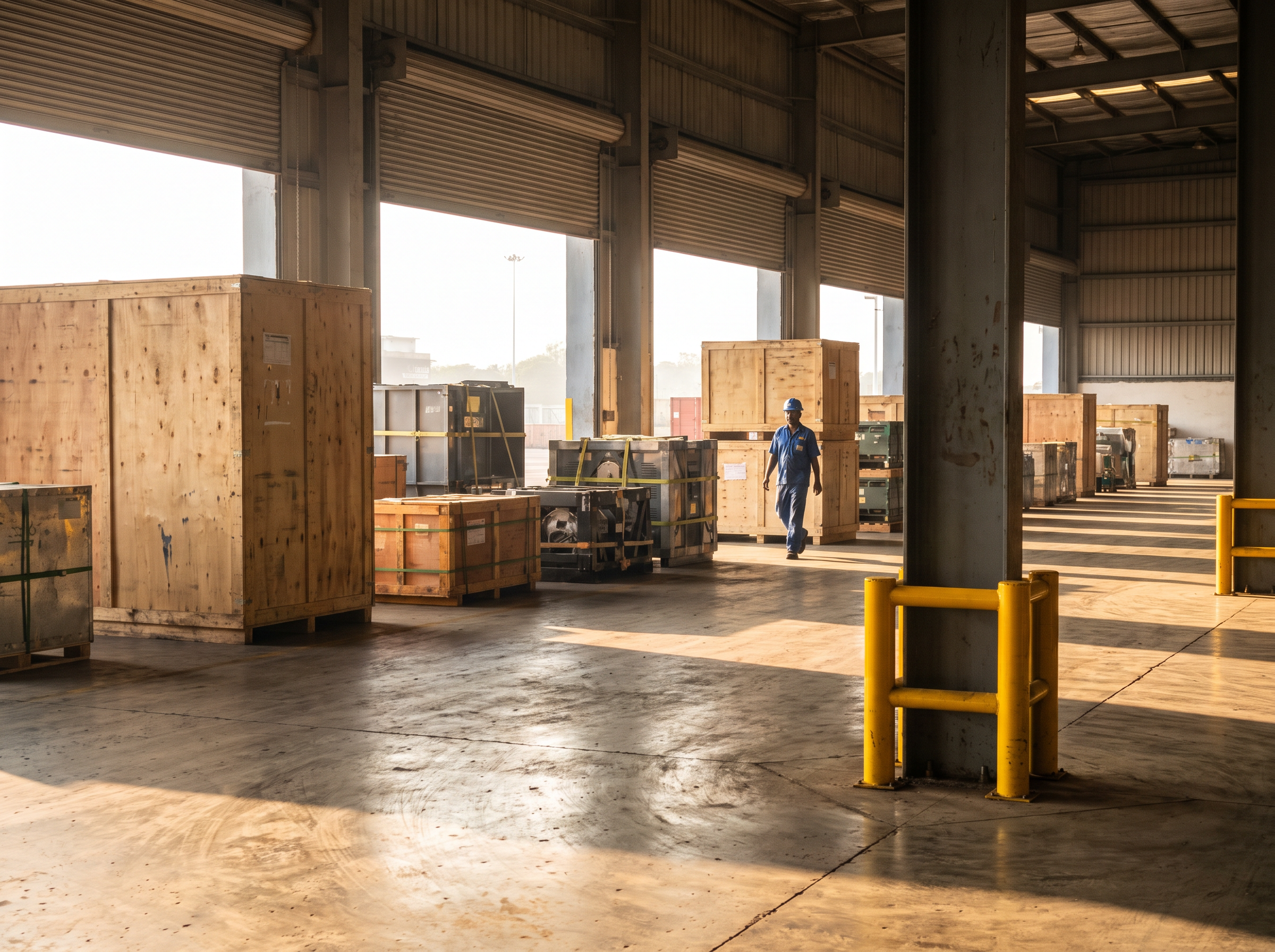 Pre-shipment staging bays where packaging defects must be intercepted before container gate-in.
High-volume container freight gives you zero second chances. Once a forty-foot container is sealed and passes the port terminal gate, fixing a single mislabeled carton turns into an operational nightmare requiring custom customs clearance intervention, physical de-stuffing, and re-inspection. According to Innormax and logistics industry data from 2026, trade operations that deploy automated document intelligence reduce customs clearance delays by 50% to 70% while cutting paperwork processing costs by 60% to 80% across high-volume freight routes.
Software automation only solves half the problem. If the physical box inside that container carries a faint Data Matrix code or an incomplete CE marking, the cleanest electronic manifest in the world will not stop overseas customs from holding the shipment.
I have seen this break plant operations firsthand across the Sriperumbudur-Oragadam belt. Tier-one suppliers ship precision machined components under brutal service-level agreements. If an automotive assembly plant in Germany or the US unpacks ten thousand crates and finds just three with unreadable orientation labels, their inbound receiving team rejects the entire batch. The Indian supplier swallows the return freight, the customs penalties, and the contractual chargebacks.
Relying on manual clipboard sampling to catch these errors is mathematically broken. An inspector checking five boxes out of a five-hundred-box pallet will miss localized label drift, smeared thermal transfer print, and missing statutory symbols ninety percent of the time. You cannot inspect quality into a product with a handheld clipboard.
Why Do Export Shipments Fail Customs Clearance at Indian Seaports?
Export shipments fail customs clearance at Indian seaports primarily due to micro-level data discrepancies and packaging defects rather than core product failures. The Central Board of Indirect Taxes and Customs (CBIC) and overseas regulatory bodies reject or detain containers when physical packaging labels, barcodes, and shipping marks fail automated optical scanning or conflict with the digital shipping bill filed through the Customs Integrated System. When carton labels are smudged, torn, or show mismatched tariff line items, automated terminal scanners flag the cargo for manual audit, triggering demurrage fees and missed vessel cut-offs.
Most plant heads assume that port holds stem from rough transit or random customs inspections. That assumption is flat wrong. Over eighty percent of clearance failures start on the packing floor before the truck ever leaves the factory gate.
A thermal printer ribbon runs low, leaving a razor-thin unprinted stripe through a GS1 serial code. A worker slaps an outdated Harmonized System (HS) code label on a crate of automotive brackets. An automated divert arm scuffs the compliance mark on a carton of surgical equipment.
None of these mistakes change the mechanical quality of the parts inside the carton. But modern container terminals do not care about your machining tolerances; they run on automated optical character recognition and high-speed scanner gates. When an automated gantry scanner at the port gate fails to decode a crate label within four hundred milliseconds, the terminal operating system kicks that container into the inspection yard.
There it sits, parked behind dozens of other flagged shipments. The vessel departs without your cargo. You pay daily container detention charges while your customs house agent spends two weeks chasing manual amendment paperwork.
Bridging the Line to the Manifest: Dual-Engine Verification
Fixing this vulnerability requires locking what is physically printed on the carton directly to what gets filed in ICEGATE and transmitted to foreign customs authorities. You cannot patch this with a generic BI dashboard. It demands hardware-accelerated computer vision mounted directly over the conveyor, synchronized with document extraction engines that verify every line item against your commercial invoices and packing lists in real time.
On the physical packing line, high-resolution industrial cameras capture every carton as it travels toward the palletizer. Using custom YOLOv8 architectures optimized for localized edge inference, the vision system verifies label presence, physical alignment, print contrast, and barcode readability. Across our production deployments, these models run at 120 items/min throughput, delivering 99.2% inspection accuracy and driving a 94% QC error reduction compared to manual audit stations.
The edge model verifies that the barcode, whether GS1-128, QR, or PDF417, strictly meets ISO/IEC print quality and edge contrast parameters. If a thermal printhead starts clogging with cardboard dust or a roll of labels shifts by three millimeters, the system alerts maintenance immediately, before ten pallets get packed with scrap barcodes.
Simultaneously, the system matches that physical data against your export paperwork. A dual-engine Document AI pipeline combining Mistral 7B and Google Cloud Vision reads multi-page packing lists, bills of lading, and certificates of origin at sub-second latency. It cross-references the physical serial numbers scanned on the conveyor against the line items on the shipping bill.
If line 42 on the packing list calls for part number 8409-B and the camera reads 8409-C on the physical crate, the line stops instantly. You resolve that discrepancy on the plant floor in twelve seconds. You do not resolve it at a maritime customs terminal twelve days later.
How Does Automated Visual Inspection Manufacturing Compare Across Vendor Implementations?
Automated visual inspection manufacturing compares across vendors based on whether the solution uses rigid legacy rule-based cameras, massive enterprise consulting frameworks, or high-speed custom edge vision linked with document parsing. Legacy vision systems handle straightforward dimensional checks but fail on distorted packaging and multi-font text, while large systems integrators deliver functional architectures only after months of billable advisory cycles. Precision edge deployments integrate specialized computer vision with sub-second document intelligence, focusing specifically on eliminating factory-to-port inspection failures with zero workflow disruption.
Understanding these structural differences is the only way an operations head can choose the right setup for their facility and shipping schedules:
| Provider | Core Architecture | Primary Strength | Where They Win Over Buteforce |
|---|---|---|---|
| Buteforce | Custom YOLOv8 edge vision paired with dual-engine Document AI | Sub-second latency; 99.2% inspection accuracy at 120 items/min; direct ICEGATE/manifest reconciliation | Pre-built catalog sensors: clients wanting simple out-of-the-box photoelectric trigger kits without custom model training. |
| Accenture | Enterprise ERP integration and global supply chain consulting suites | Global organizational change management; massive multinational IT governance | Enterprise IT transformations requiring hundreds of concurrent enterprise software integrations across multiple continents. |
| Detect Technologies | Industrial computer vision focused on workplace safety and perimeter security | Large-scale structural monitoring, thermal flare tracking, and HSE compliance in heavy industrial facilities | Heavy process industries (refineries, petrochemical plants) looking for site-wide worker safety and asset integrity monitoring. |
Accenture brings an army of consultants to rework multinational logistical frameworks. If your priority is an eight-figure, multi-year overhaul of an SAP instance spanning plants in forty countries, their scale makes sense.
Detect Technologies has built solid engineering for drone inspections and worker safety tracking across massive industrial footprints. If your primary headache is monitoring hard-hat compliance across a 500-acre refinery, they are the industry standard.
When your immediate financial bleed is export containers getting rejected at Nhava Sheva because of blurred thermal barcodes and manifest mismatches, consulting decks and perimeter CCTV feeds will not save you. You need dedicated edge computer vision inspecting cartons at line speed, parsing messy shipping bills in under a second, and stopping unverified boxes from ever being loaded into a container.
How Physical Inspection Guarantees Export Document Integrity
To guarantee that zero unverified cargo reaches a maritime port, your packaging and dispatch line needs to run as a deterministic sequence:
- Carton Arrival and Triggering: The finished carton hits the final dispatch conveyor. An optical photoelectric sensor flags its arrival and triggers the overhead industrial camera array.
- Multi-Angle Visual Verification: Custom YOLOv8 vision models evaluate the package at 120 items/min, validating label placement, structural tape seal integrity, barcode print contrast, and mandatory export markings with 99.2% inspection accuracy.
- Sub-Second Document Reconciliation: The system pulls the label serial and batch data from the frame and passes it to the document engine, cross-checking the physical package against the generated ICEGATE shipping bill and commercial packing list.
- Automated Divert or Palletization: Packages that pass both physical checks and document validation roll straight to the automated palletizer. Any package with a damaged code, unreadable mark, or manifest discrepancy gets kicked into an offline rework spur immediately.
This sequence eliminates human error from dispatch. Plants running this architecture see an ~80% average time saved across quality audits and shipping paperwork, while completely wiping out compliance chargebacks from overseas buyers.
Not a Fit If: When Custom AI Inspection Is the Wrong Choice
Deploying automated visual inspection manufacturing from Buteforce is not the right move for every manufacturer. If your facility processes fewer than two hundred units a day, or runs as a custom job shop producing bespoke, hand-crafted products with shifting dimensions every morning, building custom edge vision is a waste of capital.
In low-volume setups, a disciplined operator with a standard handheld wireless scanner will give you all the quality control you need without the overhead of edge compute nodes.
If your packaging is completely uniform, rigid, and static, and your only requirement is confirming that a single pre-printed label exists inside a fixed two-inch square, buy standard photoelectric contrast sensors from Keyence or Sick. They are cheaper, ship off the shelf, and do that specific job perfectly.
We are also the wrong fit if you want a six-month consulting engagement to produce an abstract digital transformation strategy deck, or if your shop floor team refuses to let us mount cameras and edge boxes directly over the packaging line. We write production code that runs on real factory conveyors from day one. We do not sell slide decks while your scrap rates bleed margin.
The Operational Reality of Port-Ready Manufacturing
The Central Board of Indirect Taxes and Customs (CBIC) continues to roll out its unified Customs Integrated System, consolidating ICEGATE, automated risk management engines, and terminal clearance systems into a single automated pipeline. As Indian ports transition entirely to automated gate checks, tolerance for discrepancies between physical crates and digital manifests has hit zero.
Export profitability is no longer decided strictly by how efficiently your plant casts an engine block, weaves fabric, or winds a transformer. It is decided by how reliably that finished part moves from your packaging line, through the port gates, and onto the vessel without human friction. Every manual clipboard check on your shipping floor is an unnecessary point of failure waiting to cost you ten days of demurrage.
By running automated visual inspection manufacturing alongside sub-second document intelligence, you replace shop-floor guesswork with deterministic validation. Bad labels get caught on the belt before they ever touch a pallet. Mismatched serial numbers get resolved before the shipping bill gets filed.
The container is locked, the manifest is validated, and your shipment clears the terminal gate on schedule. That is how export manufacturing is supposed to work.
Bring one workflow, its inputs, and the point where it breaks. You get a straight answer on whether it should be built, and what it would take.
