AI Web Applications Agriculture India: Why Standalone Yield Dashboards Fail Without Market Workflows
India has mapped 23.5 crore agricultural plots and registered 7.63 crore farmers under the Digital Agriculture Mission, according to PIB India's 2026 data. Satellite models can scan crop belts across Maharashtra or Andhra Pradesh and predict a bumper tomato or cotton harvest three weeks before picking begins. Yet agribusinesses and off-takers continue to bleed margin every single harvest.
The breakdown happens the second produce leaves the soil. Building enterprise AI web applications agriculture India procurement teams actually rely on requires shifting engineering focus away from advisory screens. Yield predictions without execution workflows create gluts, missed mandi windows, and administrative logjams.
When an agribusiness cannot coordinate transport, verify weighbridge slips, and lock off-taker pricing in real time, a forecast is just dead data on a screen. Closing that margin leak demands transactional systems that tie field intelligence directly into the physical supply chain.
Why Do Most Agritech Dashboards Fail to Solve Post-Harvest Losses?
Agritech dashboards fail because they deliver passive agronomic advice instead of coordinating commercial transactions between growers, procurement desks, and off-takers. While field models predict crop volume, they lack the transactional mechanics to reserve cold storage, reconcile mandi tax documentation, and dispatch transport before local spot prices crash. Without direct hooks into enterprise trade workflows, prediction software leaves 15% to 20% of harvested value stranded at the farm gate.
Predictive models often create commercial friction when detached from downstream logistics. World Bank and AgriTech Reviews field data indicates that AI-driven sowing advisories demonstrated up to 30% yield gains across trials in Andhra Pradesh and Maharashtra. However, smallholder growers and procurement aggregators still forfeit up to 40% of gross margins to post-harvest price swings and intermediary fees.
I have watched this failure play out in person: accurate yield forecasts actively destroy farm-gate profitability if local logistics cannot absorb the volume. When ten thousand growers get the exact same satellite advisory on their phones, they harvest on the exact same Tuesday. The nearest Agricultural Produce Market Committee (APMC) yard gets flooded, local spot prices crash by 40%, and enterprise buyers cannot capitalize because their procurement desks are buried under manual logistics.
A farm-gate dashboard telling a grower that their crop is mature does nothing to secure a transport carrier or negotiate freight rates. Agribusinesses do not need another mobile application showing NDVI heatmaps and soil nitrogen levels. They need multi-stakeholder web applications that convert field predictions into executed purchase contracts and automated dispatch orders.
Commercial processors do not lack crop information. They lack the operational infrastructure required to handle sudden volume spikes. When an application only visualizes agronomic data, it treats the harvest as the finish line. In commercial agriculture, the harvest is merely where financial risk begins.
The Operational Bottleneck: From Yield Forecasts to Mandi Settlement
Applied AI in Indian agriculture is projected to scale from $265.99 million in 2025 to over $3.48 billion by 2035 at a 29.3% CAGR, based on estimates from Market Research Future. That capital is finally moving away from consumer-facing farm advisory apps and into supply chain automation.
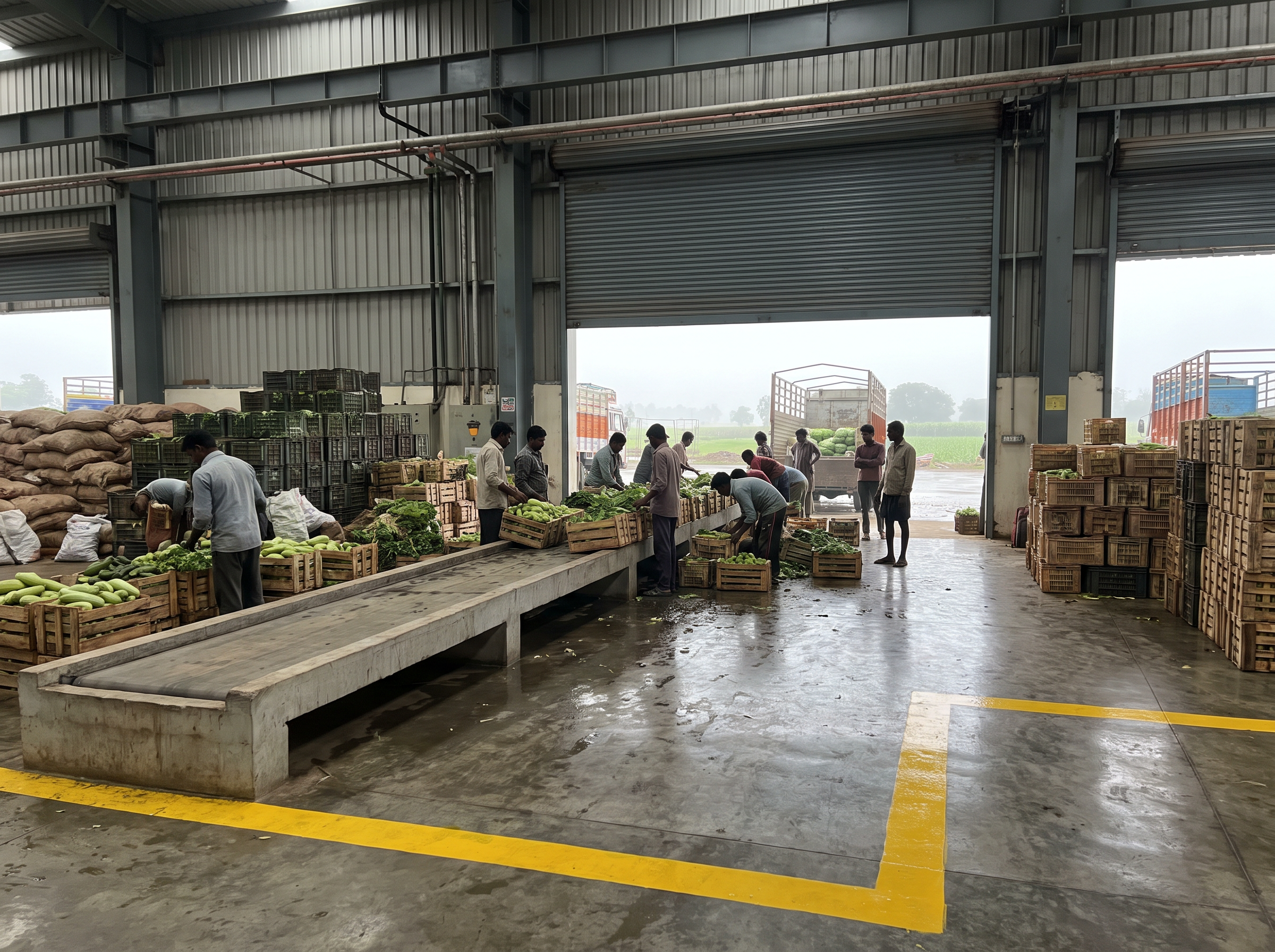
The true operational chokepoint sits between the farm gate and the processing facility. Consider an enterprise buyer purchasing dry red chilies across Guntur. The procurement team receives harvest estimates from the field, but actual fulfillment requires verifying farmer identity records, cross-referencing mandi cess payments, and auditing truck weight slips.
In traditional setups, field staff photograph crumpled, carbon-copy receipts and WhatsApp them to a central accounts office. Processing clerks manually enter net weights, moisture discounts, and bank details into legacy enterprise resource software. This process takes 36 to 72 hours per truckload.
During that delay, perishable commodities degrade, dispute rates rise, and trucks sit idling in yard queues burning diesel. A functional web application eliminates this delay by pairing document intake engines directly with procurement ledgers. Using specialized optical character recognition and extraction engines, the system achieves sub-second document latency on distorted weighbridge slips and mandi forms, eliminating manual data entry.
Across deployed workflow systems, removing physical paperwork bottlenecks delivers ~80% average time saved for logistics and finance desks. Procurement officers stop chasing missing delivery notes and start managing commodity flow.
The transition from physical paper to structured ledgers also eliminates invoice reconciliation fraud. By auditing gross and tare weights against vehicle registration databases at the point of digital capture, enterprises prevent load shrinkage that quietly bleeds road freight profitability.
Core Architecture: What Makes Agricultural Transaction Engines Work?
To replace disconnected software stacks, an enterprise agricultural web application must bridge four operational environments: government land registries, field procurement desks, wholesale buyers, and logistics networks. Rather than serving as another read-only analytics portal, the architecture functions as an active state machine where physical events, like a weighbridge tare reading or mandi gate entry, automatically trigger downstream trade confirmations, invoice reconciliations, and freight re-routing.
Dynamic APMC Pricing and Forward-Matching Engines
Spot prices across India's 2,500+ APMC mandis fluctuate hourly based on local arrivals. A web application must ingest public data feeds, compare them with historical seasonal curves, and provide actionable procurement windows.
Instead of showing a historical chart, the application automatically matches forecasted field yields against confirmed off-taker purchase orders. If spot prices in a neighboring district offer a 12% margin premium net of transport costs, the system surfaces the routing adjustment before the trucks leave the village collection center.
The application computes dynamic freight costs against regional road toll data and fuel indices. When freight rates climb faster than the destination mandi spread, the platform automatically flags alternative processing centers or cold storage facilities to protect unit margins.
Multilingual Agent Coordination Across Distributed Networks
Village-level collection centers and Farmer Producer Organizations (FPOs) do not log into complex enterprise software portals. They communicate through chat channels and voice notes.
By embedding autonomous AI agents capable of handling 70% of autonomous multilingual coordination, enterprise platforms bridge the operational divide. Field collection coordinators receive WhatsApp notifications prompting them for collection counts, load status, and moisture readings in regional languages like Telugu, Marathi, and Kannada.
Because these agents operate with 95% faster response times than human dispatchers, transport operators receive instant load confirmations and gate passes. The web application aggregates these conversations into structured SQL databases, ensuring the central procurement desk has verified visibility without forcing rural operators to navigate unfamiliar user interfaces.
The platform links these conversational updates directly to inventory management tables. As soon as an FPO lead confirms load dispatch via chat, the central warehouse scheduling system reserves an unloading bay, preventing vehicle bottlenecks outside processing plants.
Comparing Automation Approaches for Agricultural Workflows
Agribusinesses attempting to automate procurement operations generally evaluate three paths: enterprise robotic process automation (RPA), general-purpose systems integration consultancies, and custom AI web applications.
| Deployment Vector | UiPath | Accenture | Buteforce Precision Systems |
|---|---|---|---|
| Primary Architectural Focus | Desktop bot automation for legacy ERP forms | Multi-year enterprise IT transformation programs | Custom, transactional AI web applications built for production workflows |
| Data Intake & OCR Capability | Structured form templates; struggles with wrinkled, carbon-copy mandi slips | Custom integration using third-party cloud APIs | Dual-engine OCR delivering sub-second document latency on handwritten slips |
| Field Coordination Interface | Requires desktop or licensed enterprise mobile apps | Complex portals often abandoned by rural field workers | Autonomous WhatsApp agents handling 70% of inquiries across regional languages |
| Deployment Timeline | 3 to 6 months per operational workflow | 9 to 18 months of discovery, design, and deployment | Production-ready transactional system operational from day one |
| Where This Option Wins | Established corporations with existing desktop ERP bots and static forms | Global multinationals seeking broad corporate governance and enterprise IT audits | Mid-market and enterprise agribusinesses needing rapid, zero-fluff operational execution |
UiPath provides deep desktop automation for back-office enterprise systems, but standard RPA bots break the moment field inputs deviate from fixed templates. Wrinkled weighbridge paper receipts, uneven mobile camera angles, and informal local languages stall basic script automations.
Accenture excels at massive organizational restructuring, regulatory compliance roadmaps, and large-scale enterprise system replacements for multinational corporations. However, that scale brings extended implementation cycles, multi-million dollar budgets, and deep discovery overhead that mid-tier processors cannot justify.
Specialized transactional applications bypass both traps. They combine targeted document intelligence with automated dispatch workflows, eliminating human manual touchpoints while keeping interfaces accessible for non-technical field workers.
Building an effective application means accepting that rural supply chains will never conform to pristine desktop templates. The software must accommodate messy inputs at the perimeter while enforcing absolute transactional discipline at the database core.
What Does It Cost to Deploy Custom AI Web Applications in Indian Agriculture?
Deploying a custom AI-powered agricultural web application in India typically costs between $15,000 and $60,000 for initial development, followed by ongoing infrastructure maintenance between $1,000 and $4,000 per month depending on transaction volume and document processing scale. These figures cover data pipeline integration with public mandi APIs, custom document extraction models for weighbridge and APMC slips, WhatsApp-based dispatch agent bots, and real-time off-taker portals.
Costs depend on four core technical variables:
- Document Variation: Parsing standardized electronic weighbridge tickets requires less training overhead than extracting data from carbon-copy, handwritten mandi receipts across multiple states.
- Integration Complexity: Connecting directly to legacy SAP, Oracle, or tally databases takes more engineering effort than outputting clean webhooks into modern cloud architectures.
- Agent Volume: WhatsApp business API costs scale with message volume, making efficient conversation routing and autonomous resolution vital for managing operational overhead.
- Data Sourcing and Infrastructure: Ingesting satellite NDVI imagery and government Agmarknet pricing APIs requires automated normalization to keep downstream transaction models reliable.
When designed around measurable operational pain points, custom systems recover their development investment within four to eight months by preventing transport delays, eliminating invoicing discrepancies, and preventing commission leakage.
Ongoing infrastructure expenses scale predictably with transaction count rather than seat licenses. This structure prevents software costs from penalizing growth as an agribusiness adds dozens of FPOs and independent logistics partners during seasonal volume surges.
Not a Fit If: When Buteforce Is the Wrong Choice for Your Agribusiness
We do not accept every project. Buteforce is not the right partner if your business requires exploratory research prototypes, visual analytics dashboards with no transaction capabilities, or academic agronomy models. If your leadership team wants an advisory tool for smallholders to check rainfall records without integrating commercial buyers or logistics, off-the-shelf mobile SaaS applications are a better fit.
We are also the wrong choice if your procurement volume is under 200 metric tons per month, or if your engineering budget is under $15,000. At that scale, standard spreadsheets, manual WhatsApp groups, and basic accounting software are sufficient. Building custom transactional software only delivers strong returns when manual verification backlogs and delayed mandi settlement actively cost your business real capital.
Finally, we are not a fit if you need an army of outsourced systems consultants to sit on site for twelve months running scoping committees and drafting strategy decks. We build focused, production-grade systems that solve clear operational bottlenecks from day one. If your workflow problem is not clearly defined, clarify the operational breakdown before commissioning custom engineering.
Building Operational Rails for Agri-Market Execution
India's digital public infrastructure has established the base layers for modern agriculture. The Digital Agriculture Mission and state land record systems provide the foundational data layers, but public infrastructure alone does not move produce or settle commercial trades.
Closing the gap between harvest forecasts and realized enterprise profits requires software that takes action. Predicting yields matters only when that intelligence triggers transport, processes trade paperwork instantly, and matches off-takers before margins vanish.
If your agribusiness is losing margin to post-harvest delays and manual procurement workflows, stop investing in static dashboards. Focus on building the transactional systems that turn field yield into verified enterprise revenue.
Bring one workflow, its inputs, and the point where it breaks. You get a straight answer on whether it should be built, and what it would take.
