Automated Fabric Inspection System: Cutting Weaving and Knitting Defects Inline
A single export container of single jersey or twill shipped from Tirupur or Surat can rack up forty lakhs in chargebacks before the vessel even docks in Rotterdam. The culprit is almost never an entire batch of bad yarn. It is usually a recurring two-millimeter needle line or a broken pick running quietly down roll number fourteen that slipped past an operator at 4:30 PM on a Friday.
Installing an automated fabric inspection system directly onto your production machinery ends this reliance on tired human eyes. Instead of discovering weaving faults, dropped stitches, and oil spots after the fabric has already been packed, cleared through customs, and cut onto apparel tables, inline computer vision catches micro-defects at full production speed.
Modern textile mills push continuous rolls at web speeds exceeding 60 meters per minute. At that velocity, manual quality control is not an inspection strategy. It is just an expensive ritual of crossing your fingers.
Why Do Traditional Inspection Tables Miss Critical Weaving and Knitting Defects?
Traditional inspection tables miss critical weaving and knitting defects because human visual vigilance declines sharply within thirty minutes of continuous viewing. Perching table operators must scan up to two meters of rapidly moving woven or knitted fabric, tracking high-frequency patterns while enduring severe optical fatigue from overhead lighting. This physical strain causes manual inspectors to overlook between 30% and 40% of localized fabric anomalies, including thin needle lines, slubs, broken picks, and faint lubricant stains, before the material reaches the cutting floor.
The working conditions on a standard inspection frame make complete defect detection physically impossible. A fabric roll running at 60 meters per minute across a two-meter width throws 120 square meters of material at an operator every sixty seconds. Nobody's brain can process that surface area for an eight-hour shift without cognitive exhaustion setting in. The human eye saccades across the fabric surface in erratic jumps, grabbing narrow visual samples while the rest of the web blurs right past uninspected.
The financial fallout of these missed defects is dictated by the ASTM D5430 four-point fabric grading system. Under ASTM D5430, penalty points accumulate per 100 square meters based on defect length. If an inspector misses a continuous broken pick or a drop stitch that repeats every few meters, penalty points blow past acceptable export thresholds within minutes. That single recurring defect downgrades an entire 500-meter roll from Grade A export quality straight to factory seconds or scrap.
When a Grade A roll gets dumped into seconds, the mill surrenders 25% to 40% of its operating margin on that production run. Even worse: if that roll slips past internal inspection and lands at a garment factory in Bangladesh or Vietnam, the mill eats the chargebacks, de-boarding penalties, and the emergency air-freight costs to replace the yardage.
The Optical Physics: Why Area-Scan Cameras Fail on Continuous Webs
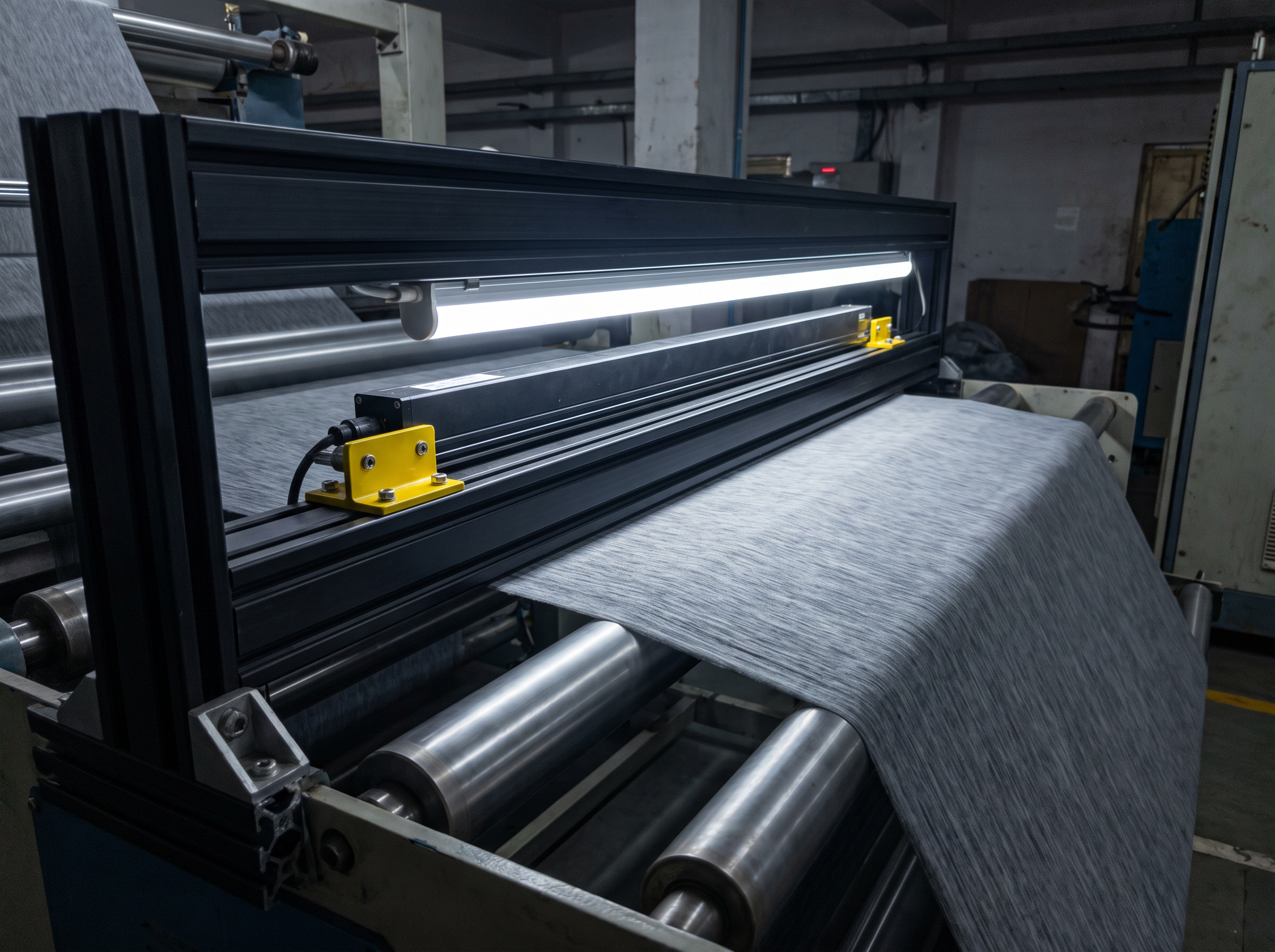 Inline line-scan optical assembly mounted over high-speed web rollers to eliminate motion blur and optical distortion.
A classic engineering mistake in textile automation is mounting standard high-resolution area-scan cameras above a stenter or rewinding frame. Plant engineers often assume that dropping a couple of high-megapixel sensor grids over the frame will let software stitch together a full-width image. In the real world, this architecture falls apart the moment you run continuous roll-to-roll yardage.
Area-scan lenses suffer from optical barrel distortion along their outer edges. When you point one at a two-meter-wide textile web, the yarn density looks warped at the borders compared to the dead center. Software can mathematically unwarp the geometry, but that post-processing introduces latency and creates interpolation artifacts. Those digital artifacts routinely trick defect detection algorithms into flagging phantom flaws, sending your false-positive rates through the ceiling.
Continuous fabric webs also suffer from mechanical micro-vibrations, elastane curl, and vertical flutter as they whip through the frame. Standard area-scan exposure times struggle to handle these micro-movements, causing intermittent motion blur. If your camera captures an image with even two pixels of blur, structural yarn defects like slubs, faint oil drops, and mispicks blend right into the natural background weave.
The reality of textile vision engineering is that adding more area-scan cameras actually makes your inspection worse. Replacing area-scan cameras with industrial single-line-scan optical triangulation and matched backlit LED arrays cuts edge-distortion false positives by over 85%.
Line-scan sensors read the fabric one single row of pixels at a time, building an unbroken two-dimensional image as the fabric travels underneath. Because the optical path stays mathematically constant across the full sensor width, optical distortion is essentially zero. When synchronized with high-frequency LED bar lights operating in both transmissive (backlit) and reflective (front-lit) modes, line-scan optics capture pure, undistorted surface texture without perspective warp.
How Does an Inline Fabric Vision System Integrate with Existing Mill Machinery?
An inline fabric vision system integrates with existing mill machinery by mounting industrial line-scan optical enclosures and rotary hardware encoders directly onto the mechanical frames of stenters, circular knitters, or take-up rolling stands. Hardware rotary encoders track the mechanical movement of the fabric drive rolls down to fractions of a millimeter, triggering camera line exposures in exact sync with web velocity. The captured image stream feeds an on-premise industrial edge computer running optimized neural networks that pinpoint defects, calculate ASTM grading points, and trigger physical roll marking devices in real time.
Deploying computer vision in a working textile mill means surviving a genuinely hostile environment. Cotton lint, airborne sizing powder, ambient heat pouring off drying ovens, and mechanical loom vibrations will kill standard commercial hardware in a matter of weeks.
A durable deployment comes down to three physical hardware layers:
- Optical Rigging and Encoder Synchronization: The optical frame mounts rigidly across the web, holding industrial line-scan cameras running at line rates exceeding 40 kHz. A high-resolution rotary encoder rests directly against the fabric drive roller, firing hardware pulse triggers to the camera sensors. If the stenter slows down from 80 meters per minute to 20 meters per minute during a batch change, the encoder pulses scale in lockstep, preventing the image from stretching or compressing.
- Dual-Spectrum Illumination Enclosures: Fabric inspection demands strict lighting geometry. Transmissive backlighting positioned beneath the web exposes yarn density irregularities, pinholes, dropped stitches, and thin picks by shining directly through the interstitial weave gaps. Front-facing directional LED bars light the top surface at precise rake angles to flag surface flaws like oil spots, foreign fibers, and surface slubs. Sealed IP65 housings with positive-pressure air purges keep ambient cotton fluff from baking onto the optical lenses.
- Edge Neural Processing Units: Raw pixel data pouring out of AI development 40 kHz line-scan cameras will choke standard office networks. The camera feeds run directly into local edge processors packed with dedicated hardware acceleration. Running optimized YOLOv8 architectures compiled down to TensorRT runtimes, the system performs sub-second inference on incoming line buffers without dropping a single frame, hitting 99.2% inspection accuracy across shifting fabric blends.
Classifying Structural Weft, Warp, and Knitting Flaws Inline
Textile defects fall into distinct physical categories governed by how the yarn is mechanically handled. A production-grade vision model has to classify every flaw accurately so loom tuners and knitting masters can fix the mechanical root cause instead of just logging bad rolls.
On rapier, air-jet, and projectile looms, mechanical slip-ups create specific structural flaws in woven yardage. Broken picks and missing weft happen when a filling yarn snaps before clearing the shed, leaving a bare transverse channel across the fabric width. Slubs and knots show up as thick, irregular yarn clumps woven straight into the structure. Threading errors produce double warp ends and misdraws that mess up surface density, while worn mechanical temple marks leave persistent vertical scoring along the selvedge.
Knitting defects show an entirely different geometric signature because of their intermeshed loop geometry. Broken needle latches or defective yarn feeders create vertical ladders, drop stitches and needle runs, that streak down the entire length of a circular knit run. Foreign colored fly fibers get spun into raw grey yarn, producing dark flecks that ruin light pastel dye lots later. Meanwhile, snapped elastane filaments cause uneven puckering across the web, and high-speed needle oil splatters leave dark, stubborn spots that resist scouring.
An automated fabric inspection system logs the exact spatial coordinates, linear meterage and cross-web position, of every single defect. Instead of relying on an operator's handwritten chalk marks on the selvedge, the system builds an exact digital roll map that syncs straight into your plant ERP.
Comparing Inline Fabric Inspection Platforms
Textile mills evaluating automated vision systems face clear trade-offs between legacy European optical systems, component machine vision providers, and edge-native AI deployments.
| Feature / Capability | Legacy European Systems | Cognex / Keyence Integration | Buteforce Custom Edge System |
|---|---|---|---|
| Hardware Architecture | Proprietary turn-key frames requiring total line replacement | Standalone industrial smart cameras and proprietary vision controllers | Edge-native line-scan rigs retrofitted onto existing stenters and perching frames |
| Detection Methodology | Handcrafted rule-based thresholding and pixel filters | Rule-based vision tools combined with generalized edge learning algorithms | Fine-tuned YOLOv8 deep learning models optimized for complex textile textures |
| Defect Accuracy | 80% to 88% on textured weaves; struggles with elastane curls | 85% to 90%; frequent false positives on subtle color variations | 99.2% inspection accuracy; delivers 94% QC error reduction inline |
| Web Speed Handling | Up to 50 meters/minute | Up to 60 meters/minute depending on lighting configuration | Up to 120 items or meters per minute with synchronized 40+ kHz line rates |
| Where This Option Is Better | High-budget greenfield installations requiring turn-key mechanical delivery | Standardized discrete parts inspection with fixed, rigid geometry | Custom integration on existing brownfield textile machinery and variable fabrics |
Cognex and Keyence make fantastic hardware for discrete factory automation. If your plant needs bar-code verification, bottle cap placement checks, or dimensional measurement on rigid packaging lines, their off-the-shelf smart cameras are benchmark tools.
Textile web inspection, however, is not a rigid packaging problem. Fabric stretches, billows, collects lint, and changes its microscopic weave texture from yarn lot to yarn lot. Rule-based machine vision controllers choke on this variance, throwing false alarms on harmless yarn hairiness or slight tension shifts.
Custom edge AI handles this variance because it inspects context, not just static pixel thresholds. Deep learning models distinguish harmless yarn count variations from real structural failures like dropped stitches or broken picks. The system adapts across raw grey goods, finished dyed yardage, and tension-sensitive stretch knits, driving a 94% QC error reduction compared to human perching.
Not a Fit If: When Your Mill Should Skip Automated Fabric Inspection
An automated fabric inspection system from Buteforce is not a fit if your mill runs short, highly fragmented custom batches under 100 meters. Facilities running vintage shuttle looms producing artisanal fabrics or wildly irregular domestic handloom runs should not invest in line-scan AI vision. The engineering overhead and dataset calibration simply will not pencil out on short, unpredictable production runs.
If your facility produces under 2,000 meters per day or cannot budget for industrial edge enclosures and encoder synchronization, do not buy this system. In those operational setups, you will get a far better return by upgrading your perching frames to high-CRI overhead lighting, enforcing clean mechanical fabric tensioning, and rotating your inspection operators every twenty minutes to limit eye fatigue. Custom vision pays for itself only on continuous, high-volume production lines where catching defects inline directly shields export margins from chargebacks.
Real-Time Defect Mapping and the Digital Cutting Room
The real ROI of an inline fabric inspection system does not stop at flagging faults on the stenter frame. It completely restructures downstream cutting room operations.
When defects are caught manually, operators stick adhesive paper tags on the fabric selvedge. By the time the roll is wound under tension, transported, and stored, half those tags have shifted, torn, or vanished inside the roll core. An automated system bypasses physical tags entirely, outputting an exact digital roll map as a structured data payload. Every single defect gets logged with its exact X-Y web coordinates, a high-resolution image crop, and its calculated ASTM penalty score.
This digital roll map plugs directly into automated nesting and cutting systems. Instead of discovering a flaw halfway through a knife pass, the nesting algorithm dynamically lays out garment patterns around defect coordinates. If a three-millimeter slub sits at meter 142, four centimeters from the left selvedge, the nesting software places a small collar band or pocket facing over that area, or routes the cut line around it entirely.
That closed-loop feedback stops defective panels from ever hitting the sewing lines. The mill dodges export rejections, slashes cutting waste, and hands apparel brands an auditable digital quality passport for every roll loaded onto a container.
Automating fabric quality control does not require ripping out your stenters, circular knitters, or perching frames. It requires mounting high-frequency line-scan optics, locking in encoder synchronization, and deploying edge models built specifically for continuous textile webs. Bring us a production roll, your current defect escape log, and the line speed you need to run: we will handle the rest of the engineering.
Bring one workflow, its inputs, and the point where it breaks. You get a straight answer on whether it should be built, and what it would take.
